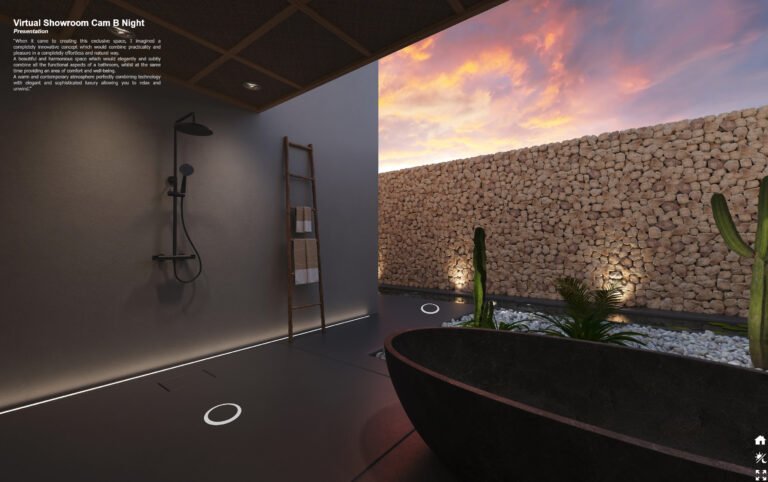
3D Rendering for Lighting: Residential, Outdoor, and Professional Projects
Visualizing Light Is More Complex Than Showing an Object
In lighting, a product is not defined only by its shape, but by how it emits and controls light. Unlike other sectors, the real value lies in the effect: intensity, beam angle, direction, color temperature, and light behavior.
For this reason, lighting visualization requires a specific approach in which 3D rendering plays a key role.
Common Lighting Types in 3D Visualization Projects
Lighting visualization projects typically involve:
- Residential lighting
- Outdoor lighting
- Technical lighting for offices
- Projects for museums and public buildings
- Architectural lighting installations
White Background Renders for Lighting Products
Rendering luminaires on a white or neutral background is common for:
- Product catalogs
- E-commerce platforms
- Technical datasheets
- Product comparisons
This type of render allows brands to:
- Clearly present product design
- Control materials and finishes
- Maintain consistency across models
- Easily scale complete product ranges
It is especially effective for extensive lighting collections.
Lighting Integrated into 3D Environments
For many lighting products, the luminaire must be shown in operation and within context.
3D environments make it possible to:
- Show how the product illuminates
- Understand real-world usage
- Evaluate interaction with the space
- Convey atmosphere and perception
These environments can be interior, exterior, or architectural, depending on the project.
Integrating Luminaires into Real Photography or AI-Generated Images
In some cases, the environment is more effectively resolved using real photography or AI-generated imagery.
The rendered luminaire can then:
- Be integrated into real spaces
- Adapt to existing scenes
- Reduce production costs
- Provide immediate realism
Always with precise control of light behavior to maintain credibility.
Technical Renders: Visualizing the Light Beam
In professional and architectural lighting, technical renders are often required to clearly show light beam behavior.
This type of visualization is used for:
- Office projects
- Museums and public buildings
- Outdoor spaces
- Functional and technical lighting
Technical Accuracy and Visual Realism
In lighting, an image that looks appealing but is technically incorrect quickly loses value.
A professional render must:
- Respect real-world proportions
- Accurately represent the light beam
- Remain consistent with technical data
- Avoid exaggerated or unrealistic effects
Achieving the right balance between technical rigor and visual clarity is essential.
The Technique Adapts to the Project
Not all lighting projects are approached in the same way.
Depending on the case, the solution may involve:
- Pure 3D rendering
- Integration into photography
- Use of AI-generated imagery as a base
- Hybrid workflows
The choice depends on the luminaire type, target audience, and the purpose of the image.
A Professional Approach to Lighting Visualization
At Mimetry, lighting visualization combines technical understanding with a photographic mindset. Each project is approached individually, selecting the most appropriate technique to accurately represent both product design and real lighting behavior.
Frequently Asked Questions (FAQ)
Can light beams be represented accurately in a render?
Yes, provided correct technical parameters and controlled lighting setups are used.
Is it better to show luminaires on a white background or in an environment?
It depends on the use. White backgrounds work well for catalogs; environments help explain real usage.
Is AI suitable for technical lighting projects?
As visual or environmental support, yes. It does not replace technically controlled rendering.
Can these images be used in real installation projects?
Yes, especially to explain concepts and validate lighting solutions.
Are they suitable for print and professional presentations?
Yes, when produced following appropriate technical standards.
Conclusion
3D rendering for lighting makes it possible to clearly communicate design, usage, and light behavior with precision and control. Whether for residential, outdoor, or professional projects, choosing the right technique ensures realistic, understandable images aligned with the real performance of the product.